What is Foundation Protocol (FP)?
Foundation Protocol (FP) is an open-source standard for trustworthy collaboration between AI agents, humans, tools, and services.
Using FP, an autonomous agent, an LLM-backed tool, a human user, or a remote service can address, message, and contract with any other entity across the network — with verifiable identity, structured sessions, and built-in trade and trust.
Think of FP like a postal system and an escrow office for an agent economy: just as the postal system gives every entity an addressable identity and the escrow office gives strangers a way to do business safely, FP provides a standardized way for AI entities to find each other, collaborate, and settle.
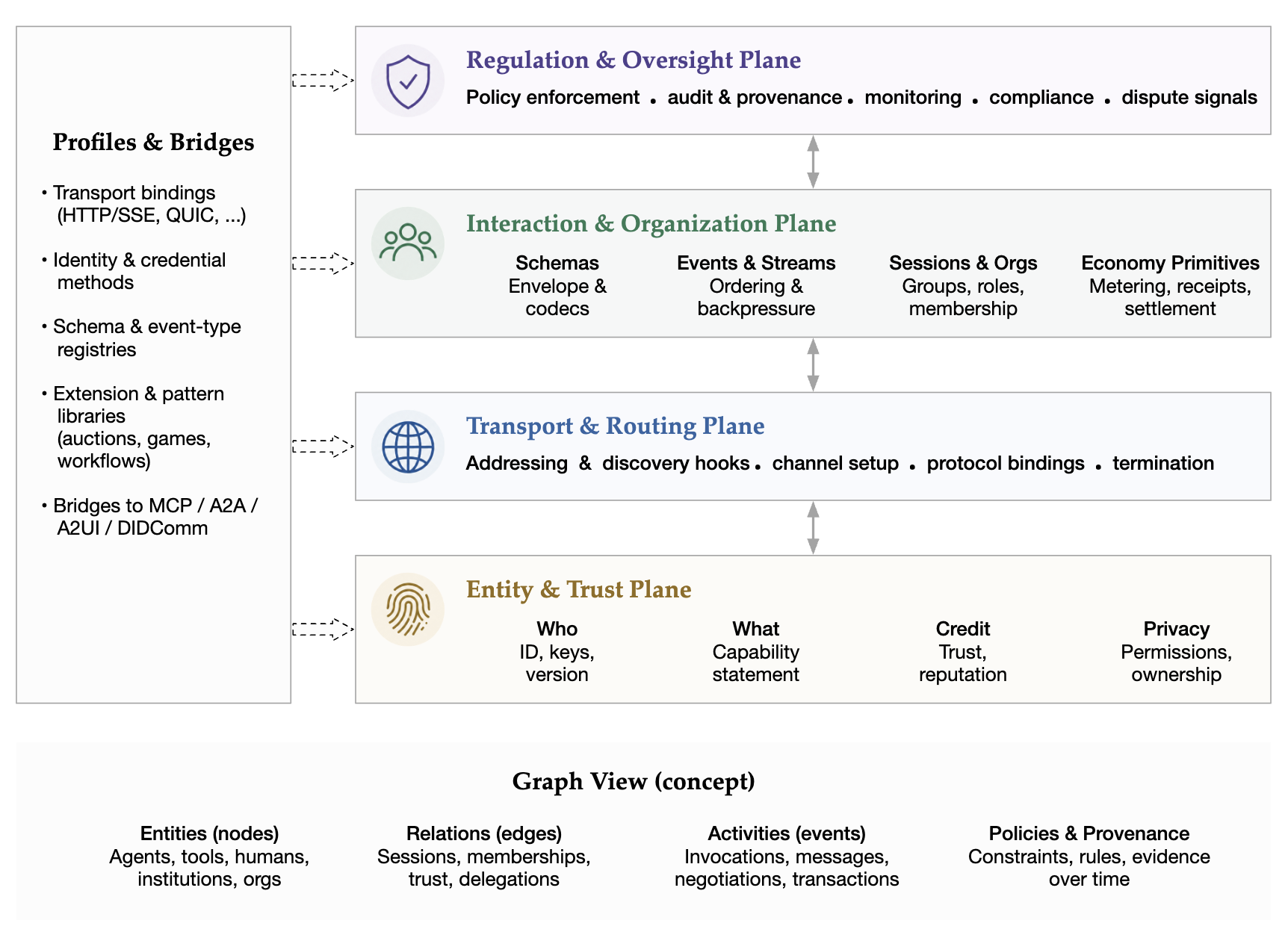
What can FP enable?
- An autonomous agent can negotiate a paid contract with another agent and settle the funds when delivery is accepted — without either side trusting a custom integration.
- A human owner can supervise a fleet of agents through a single trust layer, approving contracts, payments, and friend requests by exception.
- A tool or service can publish a capability card once and be discovered by every FP-compatible client across hosts.
- An organization can attach policy and audit hooks to every interaction, with provenance recorded as a first-class protocol output.
Why does FP matter?
- Developers — FP collapses identity, routing, sessions, policy, and trade into one runtime, so building an agent that interoperates with others stops being a stack of ad-hoc glue code.
- AI applications and agents — FP provides a shared address space and a shared evidence spine, so an agent that learns to work in one FP network can work in any of them.
- End users — FP makes it possible to trust a multi-agent system the way you trust a marketplace: verifiable identity, escrowed payments, reputation that travels with the entity.
Broad ecosystem support
FP is a control-plane substrate. It sits above point protocols like MCP and A2A rather than replacing them, and provides the cross-cutting machinery — identity, sessions, organizations, regulation, audit — that those protocols leave to each implementation. Bridges to MCP, A2A, A2UI, and DIDComm are first-class extension points.
Start Building
-
Install FP and run a minimal two-entity exchange in under a minute.
-
Register any MCP server as an FP entity — agents on the network call its tools through the normal message pipeline.
-
Use contracts, the Arbiter, escrow, and reputation to let two agents do business safely.
Learn more
-
The checkpoint pipeline, mail and message system, storage layout, and other implementation-level designs.
-
Contracts, arbitration, escrow, snapshot signing, and reputation — how two entities do business with verifiable receipts.
-
Known boundaries and risks in the current fast-iteration phase.
Quickstart
Install as a git dependency:
A minimal two-entity exchange:
import asyncio
from fp import EntityKind, Host, Message, MessageKind

async def main():
    host = Host(name="LocalHost")

    alice = host.register_entity(name="Alice", kind=EntityKind.HUMAN)
    bot = host.register_entity(name="Bot", kind=EntityKind.AGENT)

    await alice.send_message(
        to=bot.entity_card,
        message=Message(kind=MessageKind.INVOKE, payload={"text": "Hello!"}),
    )

asyncio.run(main())
More scenarios — cross-host messaging, MCP tool integration, trade
workflows — live in the
example/
directory.
Project
- GitHub — FoundationAgents/foundation-protocol
- Paper — arXiv:2605.23218 · HuggingFace
- License — see
LICENSE - Built on Foundation Protocol — AI-Link-Net